
Which Sunscreens are the Safest?
With so many choices out there, it’s hard to know which sunscreens are the best for our health. Plus, we’re of the mindset that making good choices for the planet is making good choices for people, as well. So we set out to find out which sunscreens are the safest - for our reefs and our bodies.

We’re of the mindset that making good choices for the planet is making good choices for people, as well. And, with so many choices out there, it’s hard to know which sunscreens are the best for our health. So we set out to find out which sunscreens are the safest - for our reefs and our bodies.
The best sun protection isn’t sunscreen
The best way to prevent sunburn or skin damage from sun exposure isn’t using sunscreen! It’s avoiding the sun.
Staying out of the sun is the best way to avoid sun damage and any consequences of absorbing or releasing chemicals into the environment. So instead of lathering up in sunscreen, try these alternatives as your first line of defense.
Plan outdoor activities in early morning or late afternoon (UV radiation is highest at midday.)
Find (or make) shade under a tree, umbrella, or sports canopy
Wear protective clothing, like hats, pants, and log sleeves
Protect your eyes with sunglasses
Sun avoidance is smart for all of us, but it’s especially important for infants. Keeping them out of the sun is their best strategy, until they’re at least six months old.
Protect yourself and our reefs
Research shows that some of the chemicals that prevent damage to our skin can do a great deal of damage to our reefs and oceans. In fact, one study showed that as much as 14,000 tons of sunscreen end up in the world’s reefs each year! Some places already ban these ingredients, and you can do your part by avoiding sunscreens that contain these harmful chemicals:
oxybenzone
octinoxate
octocrylene
PABA (Aminobenzoic Acid)
enzacamene
octisalate
homosalate
avobenzone
Note: Don’t wear a single product that combines sunscreen and bug repellent. If you need both, apply your bug spray first.
Learn more about the trouble with chemical sunscreens.
Chemical versus mineral
When you do have to be in the sun, swap out chemical sunscreens for mineral ones. They’re safer for our reefs, and they prevent your body from absorbing chemicals that can appear in your breast milk, urine or blood - even after just a single use. Yuck!
Mineral sunscreens are known as physical sunscreens, because they sit on your skin and reflect the sun’s rays, rather than absorbing and breaking down UV rays. Look for ingredients like zinc oxide or titanium oxide that reflect rays and provide UVA and UVB protection.
And don’t forget that you can pair your mineral sunscreen with a hat, light clothing, and sunglasses for extra protection.
Here’s a list of 10 reef-safe mineral sunscreens.
Which SPF should you use?
Generally speaking, a higher SPF is associated with greater sun protection, but that isn’t exactly the case. Why not? The ratio of UVA protection goes down as SPF increases. That means you could be exposing your skin to higher levels of UVA radiation, which deeply penetrates your skin and can cause long-term skin damage, including melanoma.
It’s true that higher SPF sunscreens can lower your risk of sunburn, but they do so with a huge cost. According to the Environmental Working Group, “U.S. sunscreens offer far less protection against UVA than UVB rays, and this is worst for products with the highest SPF values. Because UVA and UVB protection do not harmonize, high-SPF products suppress sunburn much more effectively than they do other types of sun damage. Five leading sunscreen scientists tested 20 U.S. sunscreens for UVA and UVB protection and found that just two of the seven with SPF values of 50+ and greater would pass the European test for UVA protection (Wang 2017).”

Using the highest SPF means you’re making a tradeoff: less sunburn but a higher risk of serious, long-term damage from UVA rays.
Still not convinced? Higher SPF levels tend to mean higher levels of chemicals, which can be harmful to you and to our oceans. Plus, studies show that products labeled with the highest levels of SPF may not really be high in SPF, anyway.
With this information in mind, don’t buy sunscreens with SPF higher than 50. Even if you’re prone to sunburn, products with SPF of 30 to 50 should provide enough protection.
Learn more about high SPF sunscreens and their risks.
Which is better, spray or cream?
The most effective sunscreen is the one you’ll wear, but the safest option is usually the cream. Sprays are convenient, but they release tiny particles that can irritate your lungs and might not be safe to breathe. Sprays are also harder to apply correctly, so you may miss spots and leave your skin unprotected.
How to apply sunscreen
These tips from the American Academy of Dermatology will help you apply sunscreen properly, to effectively protect your skin.
Choose a sunscreen that has an SPF of 30 to 50, is water resistant, and provides broad-spectrum coverage (UVA & UVB)..
Apply sunscreen 15 minutes before going outdoors.
Apply enough sunscreen, and rub it into your skin thoroughly. Most adults need about one ounce, or enough to fill a shot glass, to fully cover their body.
Apply sunscreen to all skin not covered by clothing. Remember your neck, face, ears, the tops of your feet and your legs. To protect your lips, apply a lip balm with a SPF of at least 15.
Reapply sunscreen every two hours, or immediately after swimming or sweating.
Sunscreen safety summary
Whichever sunscreen you choose, remember to apply it liberally and reapply it often. Also be sure to wear it whenever you’re outdoors, even in winter or on cloudy days. Being a good role model for your kids means safer fun in the sun for the whole family.
Don’t combine bug repellent and sunscreen in a single product
Choose mineral sunscreens that contain zinc oxide or titanium oxide
Look for an SPF of 30-50
Opt for creams, rather than sprays
If you use chemical sunscreen, avoid the eight reef-damaging chemicals
Apply sunscreen correctly, or avoid the sun
While you wait for your sunscreen to dry, enjoy these refreshing Strawberry Watermelon Popsicles.
Chiropractic for Childhood Bedwetting
People often think of chiropractic care as treatment for pain, but helping your nervous system work optimally can resolve all kinds of issues, including childhood bedwetting.
Often, the cause of bedwetting is simply the impairment of the phrenic nerve. If childhood bedwetting is an issue for your child, a few visits to the chiropractor may be just the trick.

People often think of chiropractic care as treatment for pain, but helping your nervous system work optimally can resolve all kinds of issues, including childhood bedwetting.
Often, the cause of bedwetting is simply the impairment of the phrenic nerve. Chiropractic adjustments can focus on the vertebrae that surround this nerve, which affects the bladder, to relieve any subluxations preventing the nervous system from functioning at 100%. If childhood bedwetting is an issue for your child, a few visits to the chiropractor may be just the trick.
An awesome example of this “miraculous bedwetting fix” is Kelsey’s story. Kelsey’s chiropractor states that she had never seen a seven-year-old look so sad. On the first visit into her center, she noticed that Kelsey wouldn’t smile and simply looked as if she were in pain. After the rundown of her issues including stomach aches, migraines, allergies, asthma and a host of other concerns, it was obvious that Kelsey had a lot on her plate.
Related: Chiropractic Provides Relief from Migraines and Chronic Pain
From all of these ailments, the thing Kelsey was most upset and embarrassed about was her bedwetting. She wet the bed multiple times every night and had never enjoyed a the joys of a sleepover with friends, for fear that she would wet the bed.
After just one chiropractic visit, Kelsey had a reduction in the number of nights she wet the bed, and she wasn’t wetting the bed as many times each night. By her third visit (two weeks after her first visit), she reported no bedwetting incidents in the past four nights. By her fourth visit, she had a planned a sleepover!
“Over the years now I have witnessed many chiropractic “miracles,” but I also understand that they are not miracles at all. They are simply the body’s innate power doing exactly what it is supposed to do once the nervous system is functioning optimally. We are born to survive and designed to thrive. Anything less is diminishing our potential, dimming our shine, and dulling our sparkle.”
A few simple chiropractic visits had “unlocked her nervous system” so that it could function at its full potential. The result was a happy and healthy child who felt “normal.”
Read more about Kelsey’s story, which was published in Pathways to Family Wellness, Issue #61.
Healthy Recipe: Summer Gazpacho
If you’re looking for something light and healthy on a hot summer’s day, it’s hard to beat a cold, refreshing bowl of gazpacho. This classic Spanish soup is full of fresh vegetables and herbs for a filling and tasty meal.
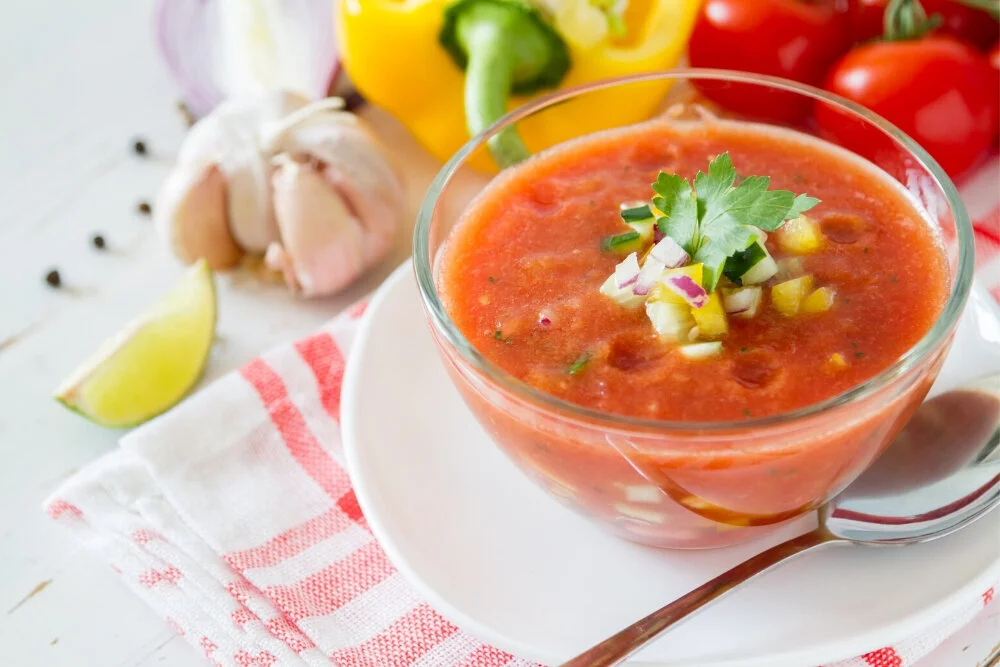
If you’re looking for something light and healthy on a hot summer’s day, it’s hard to beat a cold, refreshing bowl of gazpacho. This classic Spanish soup is full of fresh vegetables and herbs for a filling and tasty meal.
Summer Gazpacho
(adapted from epicurious)
Ingredients
2 cups chopped tomatoes
1/2 c. chopped green bell pepper
1 c. chopped, seeded cucumber
1/2 c. chopped red onion
1/3 c. olive oil
juice of 1/2 lemon
1/4 c. red wine vinegar
2 T. Worcestishire
1 t. dried oregano
1/4 c. minced parsley
2 cloves garlic, minced
46-oz. can of V8 or tomato juice
salt and pepper to taste
Tabasco, to taste
Instructions
Put chopped vegetables in a large bowl. For a smoother consistency, use a food processor to chop the vegetables.
Add V8 or tomato juice and other ingredients to the vegetables. Chill in the refrigerator until ready to serve.
Notes:
This is a recipe you can easily personalize!
The flavor gets better with time, and you can store it in the refrigerator for about a week.
Want it spicier? Try Spicy V8 or adding extra hot sauce or some minced jalapeño.
For a milder flavor, cut back on the onion and garlic.
Try garnishing the soup with parsley or minced red onion, bell pepper or cucumber.
Love tomato soups? Then try this recipe for Creamy Tomato Basil Soup.
Belly Breathing with Dr. Joe and Luna
Are you feeling mental strain from the pandemic? If you are, you’re not alone. New CDC data shows that a third of Americans are feeling symptoms of anxiety or depression thanks to the coronavirus pandemic. We’ve talked before about the benefits of deep breathing, and now, Dr. Joe and Luna are here to show you and your kids how to do belly breathing exercises that will calm your mind and relax your nervous system during anxious or stressful times.
Are you feeling mental strain from the pandemic? If you are, you’re not alone. New CDC data shows that a third of Americans are feeling symptoms of anxiety or depression thanks to the coronavirus pandemic. We’ve talked before about the benefits of deep breathing, and now, Dr. Joe and Luna are here to show you and your kids how to do belly breathing exercises that will calm your mind and relax your nervous system during anxious or stressful times.
Chiropractic as a Solution for Torticollis & Breastfeeding Problems
We love working with babies to help them function better overall. Often, that means we see babies who could benefit from gentle chiropractic care to treat issues like subluxations, torticollis, and difficulty breastfeeding. Recent research from the Journal of Pediatric, Maternal & Family Health, Chiropractic indicates that chiropractic care can help infants born with these health concerns.

We love working with babies to help them function better overall. Often, that means we see infants who could benefit from gentle chiropractic care to treat issues like subluxations, torticollis, and difficulty breastfeeding. Recent research from the Journal of Pediatric, Maternal & Family Health, Chiropractic indicates that chiropractic care can help infants born with these health concerns.
The infant in the study was a twin, who was head down, with his sister’s weight pressing on him, for must of his time in utero. As a result, he was born with torticollis, a condition that contracted his neck muscles and caused his head to tilt down. He also struggled to latch for breastfeeding, particularly on one side. A routine visit with their pediatrician wasn’t beneficial in addressing these concerns, so the parents sought chiropractic care.
Related: Chiropractic as a Solution for Breastfeeding Difficulties
After seven visits for chiropractic care, his head alignment was visibly improved, and his breastfeeding and sleeping had both improved, as well.
Read the full study to learn more about this child and other studies demonstrating that chiropractic care offers many benefits for babies with torticollis and breastfeeding troubles.
For local breastfeeding support, contact Chattanooga Lactation, LLC.
Fudge Chocolate Popsicles
An easy popsicle recipe when you need a sweet treat. This chocolate frozen dessert is perfect way to beat the heat. They are super creamy and rich for adults to love - and even better, kid approved.

An easy popsicle recipe when you need a sweet treat. This chocolate frozen dessert is perfect way to beat the heat. They are super creamy and rich for adults to love - and even better, kid approved.
Ingredients
1 C raw unsalted cashews
2 2/3 C full fat coconut can * (1 or 2 cans see below)
4-5 T maple syrup
6 T raw cacao
1/4 t salt
Directions
Combine all ingredients into a blender. Blend until it’s very smooth.
Pour in pop molds + add a pop stick. If you don’t have pop molds, use paper cups. You can cover the tops with foil or plastic wrap and poke the sticks through.
Freeze for about 3-4h.
*1 Full can of coconut milk or 2 cans and use only the solid portion. My can of coconut milk had a lot more of the solid coconut than the liquid. This may make your popsicles not as creamy if there is more liquid.
Love chocolate? Then also try these delicious gluten-free brownies.
Recipe courtesy of Maite Bou, a Holistic Nutritionist, mama of two, lover of 🥑 and founder of maitebou.com. Her passion is sharing and educating our community with fun, healthy, easy and delicious recipes, videos, and her upcoming nutrition/ cooking workshops! Maite hopes to inspire you to make your own health informed choices and live a happier, healthier and overall meaningful life!

Day 29: Our Mothers

Journal: Why are you grateful for your mom? The list might be long :)
Health & Happiness,
Dr. Becky :)


Enjoy Your Kids with Mindful Parenting
We’re all experiencing physical distancing differently. Some of us are enjoying a slower pace and having fun connecting more deeply with our families. Others can’t relate to “slower pace” at all, because they’re working, helping kids with schoolwork, keeping house, and cooking 382 meals a week. Others, still, feel both extremes, careening between boredom and overwhelm. And that’s all okay! No matter where you are on this emotional roller coaster, for Mother’s Day, try to slow down and enjoy your kids. It’s the best gift you could give yourself - and them!

We’re all experiencing physical distancing differently. Some of us are enjoying a slower pace and having fun connecting more deeply with our families. Others can’t relate to “slower pace” at all, because they’re working, helping kids with schoolwork, keeping house, and cooking 382 meals a week. Others, still, feel both extremes, careening between boredom and overwhelm. And that’s all okay! No matter where you are on this emotional roller coaster, for Mother’s Day, try to slow down and enjoy your kids. It’s the best gift you could give yourself - and them!
The days are long, but the weeks are short.
It’s true. One minute your kids are sweet-smelling, cooing infants. The next, they’re playing three sports and eating you out of house and home. The time goes by in a flash! The article, “Enjoy Your Kids,” from Pathways to Wellness, is a great reminder to work on being more present and less perfect so your time with your kids won’t pass in a busy blur.
You can be a more present parent, with these helpful tips for mindful parenting:
Mindfulness can be messy.
Those dishes in the sink will still be there in an hour. But your chance to splash in rain puddles with your son may have passed by then. Give yourself permission to make a mess, or put off a chore in favor of making a memory with your child.Help when asked.
You won’t always be able to drop everything to help, but get into the habit early of acknowledging problems and helping your kids find solutions. One day, their problems will be bigger, and you’ll want them to come to you.
Related: Helping Kids Find BalanceAccept the bad times.
Tears, temper tantrums, and sibling arguments are just part of the package. When you remember that and understand that worry, hunger, tiredness, or testing limits are at the root of the issue, it’s easier to deal with the bad times.Put away the toys. (especially the electronic ones!)
Whether you’re letting your kids play on devices, or you’re often glued to a screen, it’s time to take a break. Do a craft, play a game, have a chat - do something together that doesn’t involve a phone or computer.Keep the conversation going.
Talking and singing to your little ones builds their vocabulary and improves their ability to learn. So keep up the chatter!Relive it through writing.
Journaling has all kinds of good benefits, but when you write about your kids’ funny saying, temper tantrum over something ridiculous, soccer goal, college acceptance, or school play helps you relive those special moments.
There’s one piece of advice I’ve decided to take—to be present, and to enjoy my child the best I can.
Happy Mother’s Day!
Day 18: Photo

Journal: Take a picture to capture this day to look back on.
Health & Happiness,
Dr. Becky :)