
Strengthen Your Core with the Bird Dog Exercise
Th bird dog is an exercise for nearly any age. Whether you suffer from lower back pain or simply want to improve your balance, flexibility, posture, and core strength, this is the exercise for you. Doing it regularly may also help you prevent strains and injury. Watch this video by Dr. Joe to learn how to strengthen your core with the bird dog exercise or guide your child through the motions.
The bird dog is an excellent exercise for strengthening and stretching your lower back while boosting physical and cognitive coordination. By coordinating movements on opposite sides of your body, the bird dog exercise stimulates neurological/cross crawl activity and your spinal stabilizing musculature. If you’re unfamiliar with the phrase “cross crawl,” it refers to bilateral movements coordinated across opposite parts of the body, like your arms and legs. Other examples of cross crawl movements include running, walking, swimming, and crawling.
This type of motion simultaneously fires neurons in both hemispheres of the brain. Since physical coordination precedes cognitive coordination in our development, cross crawl motions like the bird dog exercise are excellent foundational exercises for kids.
According to Your Therapy Source, benefits of cross crawl exercises include:
building core strength
improving eye teaming skills, needed for reading, writing, and mental focus
enhancing whole-brain thinking
developing proprioception (spatial and kinesthetic awareness)
The benefits for children are clear, but the bird dog is an exercise for nearly any age! Whether you suffer from lower back pain or simply want to improve your balance, flexibility, posture, and core strength, this is the exercise for you. Doing it regularly may also help you prevent strains and injury.
Watch this video by Dr. Joe to learn how to strengthen your core with the bird dog exercise or guide your child through the motions.
Interested finding new ways to help your child thrive, physically and mentally? Try unstructured play!
Family Friendly Hiking Spots Around Chattanooga
As temperatures start to decrease this fall it is a great time to go on a hike with your family/furry friends. Here are some of our favorite family friendly hiking spots near Chattanooga:

As temperatures start to decrease this fall it is a great time to go on a hike with your family/furry friends. There are so many health benefits gained from getting out, moving, and spending time in nature. Some of these benefits include improved memory and attention, being sick less often, improved productivity, reduced anxiety, anger, and depression, improved phycological well-being, and nurturing closer relationships with one another.
Here are some of our favorite family friendly hiking spots near Chattanooga:
Big Soddy Creek Gulf - Easy wide trail with lots of creek swimming spots right along side the trail.
Website: https://soddy-daisy.org/the-big-soddy-creek-gulf-the-gulf/
Glen Falls Trail - A short out and back trail with a neat waterfall and small pool to stop and cool off at.
Website: https://rootsrated.com/chattanooga-tn/hiking/glen-falls-trail
Reflection Riding Arboretum & Nature Center - Located at the foot of Lookout Mountain, it offers many easy hiking options and other fun recreational activities such as canoe rentals.
Website: https://www.reflectionriding.org/105/maps-trails
Rainbow Lake Trail - A moderate hike down to Rainbow Lake on Signal Mountain. Enjoy the nice waterfall and cable bridge near the lake.
Website: https://rootsrated.com/chattanooga-tn/hiking/rainbow-lake-trail
Enterprise South Nature Park - This park has miles of trails ranging from easy to moderate. It is a great place to take a hike with your family and there are mountain biking trails as well.
Website: http://parks.hamiltontn.gov/148/Enterprise-South-Nature-Park
You may also enjoy our blog, Want to Feel Better? Spend Time Outdoors.
Moving Meditation During Pregnancy Calms Your Mind and Body
Walking is an excellent form of exercise at all stages of your pregnancy, and you may also find that walking gives you time to clear your head and calm your mind. You can take the benefits even further with a breath walk - a form of walking meditation.
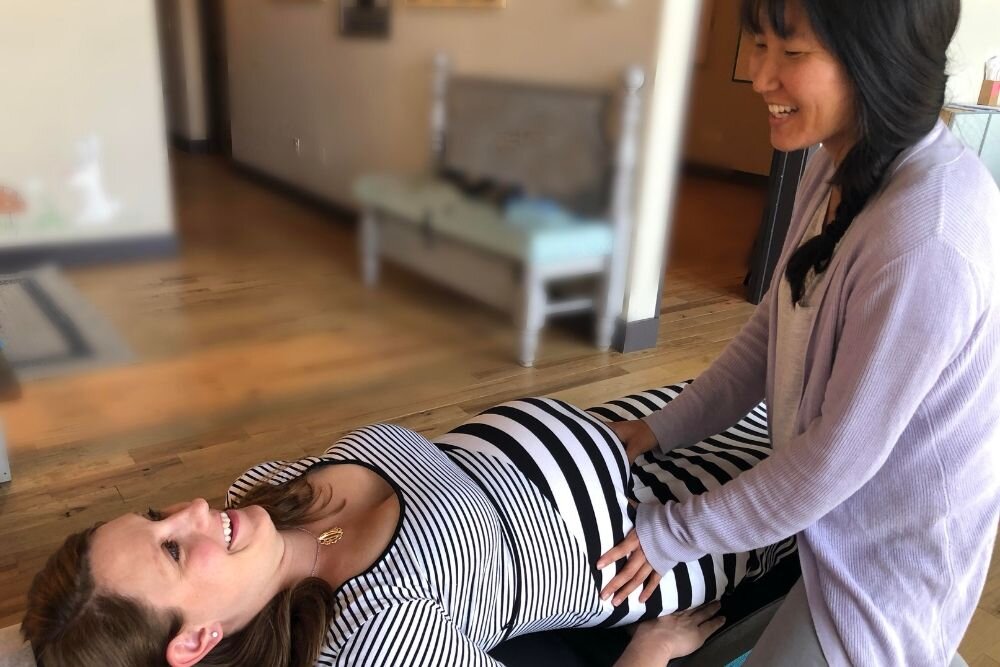
Walking is an excellent form of exercise at all stages of your pregnancy, and you may also find that walking gives you time to clear your head and calm your mind. You can take the benefits even further with a breath walk - a form of walking meditation.
When you’re getting started, find a quiet place with some room to move. With your feet shoulder-width apart, take several deep breaths. Relax your jaw, neck and shoulders, then begin breathing in a four-part rhythm:
Breathe in for four counts.
Hold your breath for four counts.
Exhale for eight counts.
Hold your breath for four counts.
Do this a few times to get used to the pattern, then begin coordinating steps with your breathing. At first, take a step with each inhale and exhale, pausing while you hold your breath. If you want to speed things up a tad, you can take four steps with each inhale and four steps with each exhale.
These breath walks are excellent preparation for childbirth and beyond, because you’re learning to “mindfully multitask.” Most women are able to walk comfortably during early stages of labor; consider doing a breath walk to calm your mind.
Learn more about breath walks in Breath Walk for Pregnancy, and learn about eight choices you can make for a healthy pregnancy on our blog.
Source: Pathways to Family Wellness magazine, Issue #26.
Chiropractic Care Keeps This Mom Fit and Strong
A mom of two, who was injured in a car wreck as a teen, describes how chiropractic care has allowed her to stay fit and strong for her kids and for her life.
A mom of two, who was injured in a car wreck as a teen, describes how chiropractic care has allowed her to stay fit and strong for her kids and for her life.
Chiropractic Care for Athletes
Amateur and professional athletes alike constantly strive to improve. They want to be faster, stronger, more flexible. Regular chiropractic care can help! Not only does it boost athletic performance, but it also speeds healing and recovery time and can help prevent injury.

Amateur and professional athletes alike constantly strive to improve. They want to be faster, stronger, more flexible. Regular chiropractic care can help! Not only does it boost athletic performance, but it also speeds healing and recovery time and can help prevent injury.
How? Chiropractic care focuses on your body’s structure, correcting misalignments and improving your nervous system’s ability to send and receive messages.
“Postural strength and coordination are essential for injury prevention and sports performance.”
Even if you’re not an athlete, you can enjoy the benefits of chiropractic in your daily life, as your body is better able to handle your daily physical activities and stressors. And, considering that nearly 36% of all injuries to children in the U.S. are caused by sports and recreational activities, it’s a good idea for your child athlete to receive chiropractic care, as well.
Read Chiropractic and Athletes for more information, and contact us to schedule an appointment.
Source: Pathways to Family Wellness magazine, Issue #07.
New Research on Athletes & Heart Rate Variability
Recent research shows that chiropractic may play an important role in improving heart rate variability in athletes. The study was published in h the Annals of Vertebral Subluxation Research.

“Research is revealing that there is a relationship between abnormalities in the spine, the nervous system, stress, training, recovery and cardiovascular health” stated Dr. Matthew McCoy, a chiropractor, public health researcher and editor of the journal that published the study. “Basic science research shows that the proper development and function of the nervous system relies on proper structure and movement of the spine from an early age.”
Research has shown not only that normal structural alignment and joint movement is crucial, but that complex neurochemical communication and pathways involved in helping humans to develop normally are tied into spinal biomechanics and their related neurological pathways.
“We are now seeing more and more basic science and clinical research showing the relationship between spinal function and its relationship to performance and recovery,” McCoy added. When it comes to athletes, adaptation, recovery, training and cardiovascular health, the nervous system is often overlooked and that is where HRV comes into play.
According to McCoy, “In a healthy organism, higher heart rate variability represents greater adaptability to stress from its internal and external environment. When the nervous system is free of obstructions, it can better regulate anatomic, physiologic, and biochemical alterations and adapt to stress and training as needed.”
The study reviews the literature on heart rate variability and its role in athletes exploring specific adaptations to imposed demand and how that principle is applied during periodized training, the role of the autonomic nervous system in the general adaptation response, contemporary views of stress and adaptation in exercise physiology and the role of heart rate variability as an objective outcome measure for chiropractic care in athletes.
Related: Chiropractic and Athletes
Despite the relatively recent interest in the central and autonomic nervous system in sports performance circles, exercise science has been investigating the relationship for several decades. Heart rate variability (HRV) is the most accessible minimally invasive means available for evaluating an athlete’s response to training. HRV is a strong indicator of physiological changes in response to training programs, prescribing exercise intensity on an individualized basis, and has been utilized to assess overtraining which is often times predominated by sympathetic activity.
In regards to the role of chiropractic in HRV and athletes, significant structural shifts can occur in the spine. These structural shifts, more commonly known as vertebral subluxations by doctors of chiropractic, result in nerve obstructions and doctors of chiropractic correct these obstructions.
Vertebral subluxations may result in altered autonomic nervous system activity. Heart rate variability is a reliable and valid tool that may be used to assess the changes in autonomic activity associated with the reduction and correction of vertebral subluxations. Controlled studies suggest that chiropractic may improve heart rate variability and that favorable changes in heart rate variability may follow reduction or correction of vertebral subluxations.
Courtesy of the Chronicle of Chiropractic.
10 Steps to Regain Your Health
If you’re like most Americans, health is the most important aspect of your life that needs improving. With these 10 steps, you can regain your health. The more of these simple practices you do, the better and more in charge of your life you’ll feel.

By Peter Braglia, D.C.
If you’re like most Americans, health is the most important aspect of your life that needs improving. Without adequate health and well-being, you can kiss most of your other goals goodbye. Declining health and vitality rob you of the energy you need to achieve your personal or professional goals.
With that in mind, I’ve created a series of simple practices—the more of these you do, the better and more in charge of your life you’ll feel.
Sit Less, Move More
As humans, we are made to move. This doesn’t mean running around on a daily basis, but rather spending a good portion of our days walking, standing and moving in general. If we don’t, our bodies rebel and our health declines. Movement is not only good for your cardiovascular health, but also for your mental health. Do some form of exercise that significantly raises your heart rate for 30 minutes at least four times a week. Remember, also, to break up your sitting and move frequently during the day.
Related: Confessions of an Old Mom - It’s All “Gym” Dandy
Get More Sleep
Sleep is often the single most undervalued behavior in our lives—and yet it is the one with the most immediate power to improve our lives in every waking moment. If you’re averaging less than six hours of sleep, aim to get just one more hour a night. It will leave you feeling more physically energized, emotionally resilient and mentally clear.
Eat Less, More Often
Food is fuel, and real food—healthy proteins, vegetables (complex carbohydrates) and fruits —are high-octane fuel. You feel best when you eat in small doses throughout the day, beginning with breakfast. Try for more local and organic fruits and vegetables. Remember, the fresher the food, the more potent its nutrients.
Related: Healthy Family-Friendly Meals and Snacks
Remove Interference
Chiropractic care can literally change your life, and enable you to live a pain-free life full of energy and vitality. That’s because chiropractic adjustments help reduce or eliminate pressure on your nerves—the same ones responsible for your everyday bodily functions. Chiropractic will help eliminate pain and inflammation, reduce fatigue, and restore normal nerve flow to all your organs, giving you the energy, drive and peace of mind to go out there and live life the way it was meant to be lived.
Renew More
Human beings are not designed to work eight or more hours straight. We’re meant instead to alter between moving (spending energy) and resting (renewing energy). Ideally, take a break every 90 minutes, even if only to spend a minute or two stretching or breathing deeply. It all matters, and it all adds up.
Be Present
The greatest gift you can give someone is your undivided attention. After all, it’s better to be fully present with someone for an hour than physically present, but distracted, for multiple hours. Shut off your phone at a certain time each day, and practice being present with your family and friends.
Gratitude Adjustment
We’re far quicker to notice what’s wrong in our lives than we are what’s right. Gratitude has tremendous power; if it is sincere and heartfelt it makes a big difference to our outlook. To help change this mindset, once a week aim to write a note of appreciation to someone who deserves it, telling the person precisely what you’re grateful for.
Do The Most Important Thing First
Early in the morning (after your coffee), you’re likely to have the most energy, and the fewest distractions. Start your workday by focusing without interruption on the most important or challenging task you can accomplish that day.
Feed Your Mind
Our brains work better if we challenge them, and life becomes more interesting when we do. Reading is, of course, a simple way to learn and grow, but so is building a daily practice around learning a new language, a sport, an instrument, how to fix a car, or learning to draw.
Give Back
Lending a helping hand not only aids others in need, but it’s also very rewarding. Throughout the year, aim to take some time to add value to the world at large by supporting charities, standing up for great causes, or giving back to your community.
Courtesy of Pathways to Family Wellness.
Chiropractic and Athletes
Athletes have been benefiting from Chiropractic care for many years; however, it has only recently been receiving attention from the media. Athletes of all types, from the weekend warrior to the world-class athlete, utilize Chiropractic because it is a drug-free way to better health and performance.
Chiropractic adjustments help ensure that the body functions as efficiently as possible, which can maximize healing and recovery from all types of injuries.
The science of chiropractic is founded on the premise that a proper nerve supply is essential to controlling and regulating the functioning of the human body.
The nervous system controls every activity in the body by sending and receiving nerve messages and is protected by the bones of the spine called vertebrae. When the spine is in its optimal structural position, the nerves are protected, and optimal communication exists between the central nervous system and the rest of the body. The vertebra of the spine are susceptible to certain stresses and forces, which can cause them to lose their proper position.
These minor misalignments of the spine, which are known as “vertebral subluxations,” cause nerve interference and weaken the entire structure of the spine. Athletic training can often jar and misalign the spinal column, because the spine is at the center of the body. Impact to the legs, feet, head, shoulders and torso often radiates to the spine.
Doctors of Chiropractic detect and correct vertebral subluxations by physically adjusting the spine. This restores the spine and nervous system to a more optimal level of function, which maximizes the body’s performance and healing potential.
Anyone who engages in athletics can benefit from regular chiropractic checkups to ensure that their spine is balanced and free from structural stress and subluxations. When the spinal column is brought into balance and alignment, the body’s nervous system and body biomechanics (movement and posture) are maximized.
Courtesy of Pathways to Family Wellness. Read full article.