
Real Self-Care for Moms
So often, self-care suggestions for moms are things like bubble baths and manicures, which are perfectly nice, but don’t really do more than offer a few minutes of solitude before re-entering the hectic world of parenting. Real self-care for moms involves more than an hour of relaxation; it’s learning behaviors and tools that support good mental and physical health and allow us to calm our stress.
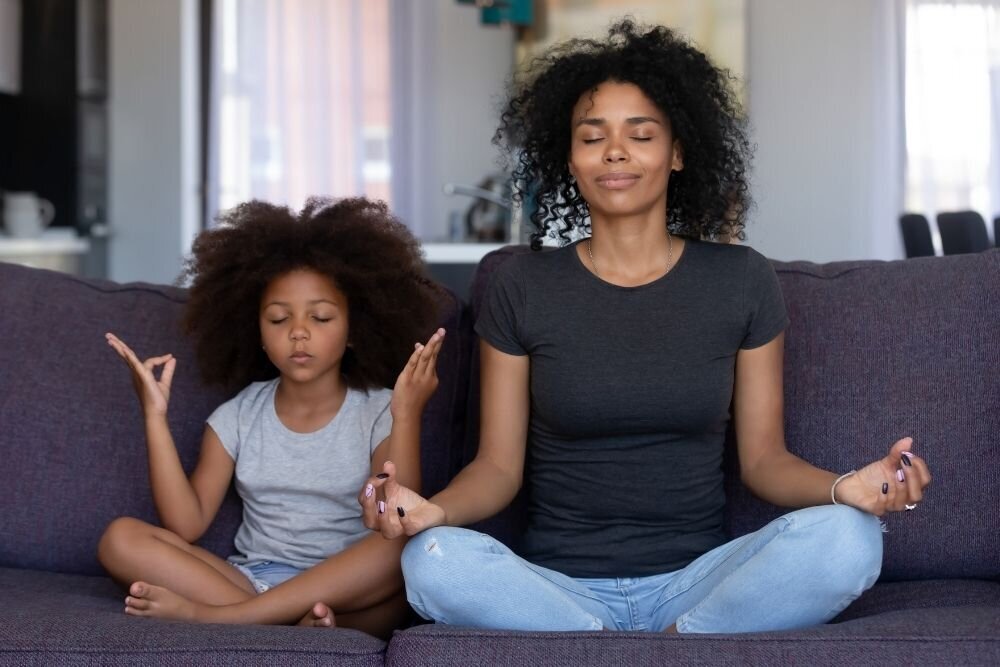
So often, self-care suggestions for moms are things like bubble baths and manicures, which are perfectly nice but don’t do much more than offer a few minutes of solitude before re-entering the hectic world of parenting. Real self-care for moms involves more than an hour of relaxation; it’s learning behaviors and tools that support good mental and physical health and allow us to calm our stress.
“Self-care for mothers means we have a tool kit for daily living, not a “break glass in case of emergency” escape plan.”
Psychologist Christine Meinecke may say it best. She defines self-care as:
“…choosing behaviors that balance the effects of emotional and physical stressors: exercising, eating healthy foods, getting enough sleep, practicing yoga or meditation or relaxation techniques, abstaining from substance abuse, pursuing creative outlets, engaging in psychotherapy. Also essential to selfcare is learning to self-soothe or calm our physical and emotional distress.”
We love how Sarah Rudell Beach broke it down further, in Pathways to Family Wellness. She says:
“…Meaningful self-care for mothers, I would argue, means that we feel truly nurtured and whole where we live day after day…in the crazy zoo of raising little children!
It means we engage in sustainable and doable practices that promote well-being and act as antidotes to the frazzling created by the day-to-day work of parenting.
It means we find ways to be present. It means we find ways to cultivate compassion—for our children and ourselves.
It means we take time for silence—for prayer, meditation, or just three deep breaths—so that we have a stillness and peace that sustains us during the crazybusynoisy moments of our day.’
Parenting is messy, and hard, and funny, and exhausting, and sometimes, more than you think you can handle. But you can do it, mama!
A fundamental element of real self-care for moms is mindfulness, being in the moment, without judgment. Mindfulness offers up space to breathe and think, rather than reacting on autopilot. Mindfulness won’t make your baby cry less, your toddler stop wetting the bed, or your teenager stop pushing boundaries. But it will help you find the mental space to parent with more clarity and peace.
You might also enjoy our blog, For specific suggestions to help you be a more present parent - without trying to be a superhero! -visit our blog, Enjoy Your Kids with Mindful Parenting. If you’re new to mindfulness practice, you may also enjoy reading about How Meditation Changes Your Brain.
Give yourself the gift of self-care this year by learning more about mindfulness and finding ways to take care of your own physical and mental health.
Confessions of an Old Mom-The Heart of the Matter
Being an “old mom” means more than facing the expected changes in parenting; it means facing unexpected changes in personal health matters as well. Sometimes, adjusting my attitudes to fit the new, more enlightened times proves just as difficult as adjusting to the actual age-related health struggles.
Being an “old mom” means more than facing the expected changes in parenting; it means facing unexpected changes in personal health matters as well. Sometimes, adjusting my attitudes to fit the new, more enlightened times proves just as difficult as adjusting to the actual age-related health struggles.
About fifty years ago, my grandmother was diagnosed with “heart trouble”. Although now recognized as angina, I had no idea what to expect when my mom advised me to be “careful” around Grandma because she had a “fragile” condition. To me Grandma seemed nearly the same as always. Granted, she relied more on my parents, her kids and her grandkids to complete household chores and errands. And, she gave up gardening. When I looked out my bedroom window, I especially missed seeing the bed of moss roses that ran along the side of her house.
She also began using nitroglycerin pills whenever she had an “attack”. Whenever Grandma was in the car with us, I remember my brother and me warily eying up her purse wondering if the nitro pills inside would blow us all to kingdom come. After all, we had watched enough westerns in our time to know that nitroglycerin was highly explosive!
And, to me, that was the entire extent of the impact my Grandma’s condition. She lived into her early 80's. And, her death was not heart-related.
Fast forward many years. I am experiencing heart palpitations. My heart rate is extremely fast. Testing shows some abnormalities. What is happening? Do I have “heart trouble”? Will I need to carry nitroglycerin to counteract my “attacks”? Must I curtail my activities? (Thank goodness I have no moss roses to be neglected!)
I am diagnosed with supraventricular tachycardia (SVT). I am told this is MUCH better than ventricular tachycardia. I am given medication for the heart palpitations. I am told to continue my life as usual with no real restrictions on activities. In fact, I am encouraged to exercise regularly. It is good for the heart. Say …WHAT?
Why is this advice so different from that given to my grandmother? What has changed in treating heart disease? Well, I learn several things have changed, actually. Extensive research shows that exercise, diet and life style changes all play vital roles in heart health. Much more is now understood about how each of these factors affects the heart. For example, often high inflammation levels in our heart vessels cause problems and reducing these levels of inflammation can improve heart function. Both drug interventions as well as natural treatments are available and recognized. The acknowledgement that the heart functions as part of our entire bodily systems is also recognized. Treating the entire person, rather than one “part”, is becoming the norm. So, instead of “heart trouble” automatically limiting a life, it simply becomes a consideration in living a life.
I would like to say that I have adapted well to my diagnosis and embrace the “new” attitude whole-heartedly (no pun intended!) But, this “old mom” still sometimes has difficulty erasing the idea that a person with a heart condition is “fragile”. Of course, the fact that I do not feel fragile helps tremendously! As someone not completely used to healthy diet and regular exercise, I do struggle somewhat. But, I am making little changes. And, as I see the positive results of those changes, I am encouraged to continue along this path. I am grateful to live in a time that has so many more options for care available than in my Grandma’s day. This allows this old mom to “take heart”!
By guest-blogger Joy Johnson